
Behind most growing restaurants is a system that most diners never see — a connected set of digital channels, content workflows, and measurement routines that bring new guests in, convert their attention into reservations and orders, and bring them back after the first visit. Building that system is what a restaurant digital marketing agency does. Not running individual campaigns, not managing a social media account, not fixing a Google listing — building the full infrastructure that makes restaurant growth repeatable.
Primi Digital is a restaurant digital marketing agency that works exclusively with restaurants and hospitality brands. This guide explains exactly how that system gets built — what goes in, how the pieces connect, and what a restaurant looks like on the other side of a program that is working.
Key Takeaways
• A restaurant digital marketing agency builds a connected system — not a collection of individual services. The channels work together or they underperform individually.
• Local search and Google Business Profile are the foundation of every restaurant digital marketing system. They capture the highest-intent diners at the moment of decision.
• The strongest restaurant digital marketing programs treat content as a shared asset — one production investment that multiplies across social, SEO, paid, and email.
• A restaurant digital marketing agency that specializes in hospitality understands the specific dynamics of covers, service windows, seasonal menus, and reservation systems that generalist agencies do not.
• Primi Digital builds restaurant digital marketing systems exclusively for restaurants and hospitality brands, with every engagement built around measurable business outcomes.
Get Free Consultation
Read more about our Restaurant Marketing Solutions!
Why Restaurant Digital Marketing Requires a Specialist
A restaurant digital marketing agency that works across industries — retail, healthcare, professional services, e-commerce — approaches every client with the same general digital marketing toolkit. The tactics are familiar. The industry dynamics are not. And in restaurant marketing, the industry dynamics are everything.
The specific ways restaurant digital marketing differs from general digital marketing:
- The purchase decision is local and fast. A diner searching for somewhere to eat is deciding in minutes, not days. The restaurant digital marketing system has to be present and persuasive at that exact moment — which requires a different approach to local SEO, paid search, and conversion than most industries.
- Discovery happens on maps, not just on websites. Google Maps and the local pack are where most restaurant discovery begins. A restaurant digital marketing agency that does not prioritize map presence and Google Business Profile optimization is missing the primary channel.
- Reviews are a direct revenue driver. Not just a reputation consideration — a measurable factor in local search ranking, click-through rate, and conversion. A generalist agency treats reviews as passive feedback. A restaurant digital marketing agency builds active systems around them.
- Seasonal and menu changes require constant content and SEO updates. A restaurant menu changes quarterly, sometimes monthly. Each change is a restaurant digital marketing event — new keyword opportunities, new content assets, new paid creative. A generalist agency treats menu updates as a client communication. A specialist builds them into the workflow.
- The economics are cover-based, not impression-based. Restaurant digital marketing success is measured in reservations, covers, and orders — not in reach, impressions, or engagement. An agency that does not connect its work to those outcomes is optimizing for the wrong thing.
The System a Restaurant Digital Marketing Agency Builds
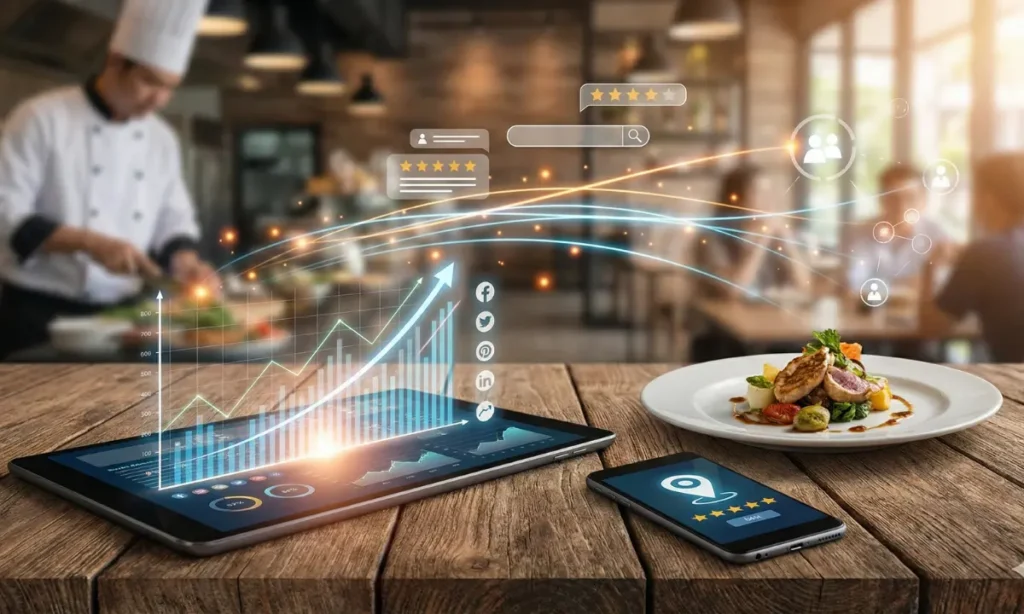
A restaurant digital marketing agency does not deliver a set of services. It builds a system — a connected program where each channel feeds the next and the whole produces more than the sum of its parts. Here is how that system is constructed.
Layer One: Local Search Foundation
Every restaurant digital marketing system starts with local search. This is the channel where diners with the highest purchase intent — people actively looking for somewhere to eat right now — discover restaurants. Winning in local search means winning at the moment that matters most.
The local search foundation a restaurant digital marketing agency builds covers two things: Google Business Profile optimization and local SEO on the restaurant’s website.
Google Business Profile management is ongoing, not a one-time setup. A restaurant digital marketing agency maintains the profile as a live channel — adding photos weekly, publishing short content updates about specials and events, managing the Q&A section, and responding to every review. The algorithm treats an active, frequently updated GBP as a signal of relevance. The practical outcome is higher ranking in the local pack and more direction requests, website clicks, and reservation actions from high-intent diners.
Local SEO on the website extends that reach. A restaurant with dedicated landing pages targeting keywords like ‘private dining [neighborhood],’ ‘birthday dinner [city],’ or ‘best [cuisine] near [area]’ captures intent that GBP alone does not reach. A restaurant digital marketing agency builds and optimizes these pages as part of the foundation — not as an add-on.
Layer Two: Social Media Content System
Social media is the discovery and retention engine of the restaurant digital marketing system. In 2026, short-form video on Instagram Reels and TikTok is the only format with meaningful organic reach for new audiences. A restaurant digital marketing agency builds a content system around this reality — not around the formats and posting frequencies that made sense five years ago.
What a restaurant digital marketing agency builds for social media:
- A weekly content production workflow — a defined filming block that produces short videos and photography for the week, batched in advance so quality and consistency do not depend on daily bandwidth.
- A content calendar with defined post types — dish features, process content, staff moments, event content, UGC reposts, and seasonal campaigns — assigned to specific days and channels.
- A channel strategy matched to the restaurant’s concept — Instagram as the primary conversion and retention channel for most restaurants, TikTok for concepts with strong visual identity or story, GBP for high-intent local reach.
- A UGC system — prompts, in-venue QR codes, and a consistent repost routine that turns guest content into a discovery channel the restaurant does not have to produce.
The social media content system a restaurant digital marketing agency builds is not designed to maximize posting frequency. It is designed to produce the right content consistently, on the channels where the target diner makes decisions, with a clear path to conversion at every touchpoint.
Layer Three: Paid Acquisition and Retargeting
Paid restaurant digital marketing is the precision layer of the system — the channel that reaches diners with specific intent at specific moments, and re-engages those who have already shown interest. A restaurant digital marketing agency builds paid programs around two distinct objectives: new guest acquisition and retargeting.
New guest acquisition through paid search targets high-intent keywords at the decision moment. A diner searching ‘private dining restaurants [city]’ or ‘best Italian restaurant near me’ is already deciding. A well-built paid search campaign ensures the restaurant appears at that moment with the right message and a destination page built to convert. A restaurant digital marketing agency structures these campaigns around reservation and order conversion — not clicks or impressions.
Retargeting is the most cost-efficient paid channel in restaurant digital marketing. It reaches people who have already engaged — visited the website, clicked a menu link, viewed a social post — at a fraction of the cost of cold acquisition. A retargeting campaign showing a past website visitor a compelling dish visual and a clear reservation CTA converts at a significantly higher rate than any awareness-stage ad. A restaurant digital marketing agency builds retargeting into the program from the start, not as an afterthought.
| Paid Channel | Role in the Restaurant Digital Marketing System |
| Google Search Ads | Capture high-intent ‘near me’ and occasion searches at the decision moment |
| Meta / Instagram Ads | Reach local audiences by demographics and interest; retarget website visitors |
| Retargeting (cross-platform) | Re-engage past visitors and social engagers at low cost with high conversion intent |
| Local inventory / map ads | Appear in Google Maps results for local searches — extends GBP visibility |
| Boosted social content | Turn high-performing organic content into paid reach for lookalike audiences |
Layer Four: Email and SMS Retention
The owned channel layer of the restaurant digital marketing system is where first-time guests become regulars. Email and SMS are the channels a restaurant controls — no algorithm, no platform fee, no competition for reach. A restaurant digital marketing agency builds the infrastructure to capture contacts, grow the list, and use it to drive repeat visits and revenue.
Email in restaurant digital marketing is most effective for: event and private dining announcements, seasonal menu launches, loyalty program communication, and re-engagement of lapsed guests. The restaurant digital marketing agency builds segmentation into the program — so a guest who dined for a birthday receives a relevant anniversary message, not a generic newsletter.
SMS has higher open rates than email and is best used for time-sensitive communications: reservation reminders, limited-time offers, event capacity alerts, and loyalty program updates. A restaurant digital marketing agency builds SMS into the post-visit flow — capturing opt-ins through the reservation system, the loyalty program, and social media CTAs.
The list-building strategy is as important as the send strategy. A restaurant digital marketing agency designs opt-in moments across every touchpoint — reservation confirmation flows, post-visit follow-ups, social media lead magnets, and loyalty program sign-ups — so the owned audience grows consistently alongside the restaurant.
Layer Five: Reputation and Review Management
Review management is one of the most underbuilt layers in most restaurant digital marketing programs — and one of the highest-leverage. A restaurant digital marketing agency treats reputation not as a passive outcome but as an active system with measurable impact on local search ranking and conversion.
The review system a restaurant digital marketing agency builds:
- A consistent ask cadence — post-visit messages, table prompts, and server training that make the review request a natural part of the guest experience.
- Frictionless mechanics — a short link or QR code that goes directly to the Google review page, not to the homepage or a review aggregator.
- A response routine — every review responded to within 48 hours, specifically and personally, mentioning the dish or occasion. Responses signal attentiveness to future diners and keyword relevance to the algorithm.
- Theme tracking — recurring positive feedback becomes marketing copy; recurring complaints become operational priorities communicated to the client.
Review velocity — the rate at which new reviews come in — is a local search ranking signal. A restaurant digital marketing agency that ignores this layer is leaving a meaningful ranking and conversion lever untouched.
Layer Six: Content Marketing and SEO
The long-term authority layer of the restaurant digital marketing system is content marketing — blog articles, neighborhood guides, occasion-specific landing pages, and menu explainers that build organic search visibility over time. A restaurant digital marketing agency builds this layer with keyword research that identifies the search terms diners use when they are in the consideration phase — not yet at the decision moment, but moving toward it.
Content restaurant digital marketing assets that compound over time:
- Location and occasion pages — ‘best restaurants for a date night in [neighborhood],’ ‘private dining options in [city]’ — that capture consideration-phase searches and build internal link authority.
- Menu and cuisine explainers — content that ranks for diners researching specific dishes, dietary requirements, or cuisine types before choosing a restaurant.
- Neighborhood and local guides — content that positions the restaurant as a local authority and captures geo-modified searches that competitors often miss.
A restaurant digital marketing agency produces this content as part of the system — not as a standalone SEO add-on. Each piece is connected to the social media calendar (repurposed as posts and Stories), the email program (shared with the list), and the paid program (used as landing pages for search ads).
How the Layers Connect: The Compounding Effect
The restaurant digital marketing system produces compounding results because each layer feeds the next. The output of one channel becomes the input of another, and the cost of reaching and retaining each guest decreases as the system matures.
How the connections work in practice:
- A Reel that performs well organically is boosted as a paid ad to a local lookalike audience — turning organic traction into paid efficiency without additional creative production.
- Blog content that ranks in search is shared via email and social media — one production investment that reaches the audience through three channels.
- GBP posts repurpose Instagram content — every piece of visual content serves two channels with 60 seconds of additional effort.
- Review responses that mention specific dishes and neighborhood context contribute to local search keyword relevance — connecting reputation management to SEO outcomes.
- Social media CTAs that drive email sign-ups reduce future paid acquisition costs — because the restaurant can reach those guests directly next time at no incremental spend.
- Email re-engagement campaigns that bring lapsed guests back produce reservation data that informs paid retargeting audiences — closing the loop between retention and acquisition.
This is why the restaurant digital marketing agency model produces different results than individual service vendors. A social media agency, an SEO agency, and an email provider working independently produce three disconnected channels. A restaurant digital marketing agency builds one connected system where each layer multiplies the others.
What the System Looks Like in Practice: The Primi Digital Approach
Primi Digital is a restaurant digital marketing agency that works exclusively with restaurants and hospitality brands. The system described in this guide is what Primi Digital builds for every client — adapted to the restaurant’s concept, market, goals, and current starting point.
The Engagement Starts With Strategy
Before any channel is activated, Primi Digital starts with a strategy conversation. What is the restaurant trying to achieve? Where are the current gaps — in visibility, conversion, or retention? What does success look like in terms the business actually uses? The restaurant digital marketing program is built around the answers to those questions. Services follow strategy. They are never the starting point.
Local Search Is Always the Foundation
Every Primi Digital restaurant digital marketing engagement starts with local search. Google Business Profile optimization and local SEO on the website are the first investments because they reach the highest-intent diners at the lowest cost per acquisition. Everything else in the system is built on top of that foundation.
Content Is Produced Once and Deployed Everywhere
Primi Digital builds content systems that treat every asset as a shared resource across channels. A dish video produced for Instagram becomes a GBP post, a paid ad creative, and an email header. A blog article produced for SEO becomes a social post series and an email campaign. The goal is maximum channel coverage from minimum production investment — which is what makes the restaurant digital marketing system sustainable at the pace required to compete in 2026.
Measurement Is Connected to Revenue
Primi Digital reports on restaurant digital marketing performance in business outcomes. Not impressions, not followers, not engagement — reservation volume, cover trends, online order growth, email list growth, review velocity, and channel-attributed revenue. Every monthly review connects the work to the result and produces a short list of adjustments for the following month. The system improves every 30 days.
Frequently Asked Questions
What does a restaurant digital marketing agency do?
A restaurant digital marketing agency builds and manages the connected digital marketing system that drives growth for a restaurant — covering local SEO, Google Business Profile management, social media content, paid search and retargeting, email and SMS marketing, reputation management, and content marketing. The agency is responsible for strategy, execution, and measurement across all of these channels, with everything connected around the restaurant’s specific growth goals.
How is a restaurant digital marketing agency different from a generalist digital agency?
A restaurant digital marketing agency is built specifically around the dynamics of the hospitality industry — local search behavior, cover-based economics, seasonal menu changes, reservation systems, review velocity, and the fast, local nature of the restaurant purchase decision. A generalist agency applies the same digital marketing toolkit across industries. The restaurant-specific knowledge is what determines whether the system is built around how diners actually make decisions — or around generic digital marketing best practices that do not account for how restaurants grow.
How long does it take for a restaurant digital marketing system to produce results?
Different layers of the system produce results on different timelines. Paid search and retargeting typically produce measurable results within 30 to 60 days. Google Business Profile optimization and social media content show meaningful impact over two to three months of consistent execution. Local SEO and content marketing build ranking authority over three to six months. The full system — all layers connected and compounding — typically produces its most significant results between six and twelve months into the engagement.
What should a restaurant expect to pay for a digital marketing agency?
Restaurant digital marketing agency retainers vary significantly by scope. A program covering one or two channels typically starts around $1,500 to $2,500 per month. A full-system engagement covering local SEO, social media, paid acquisition, email, and reputation management typically ranges from $3,000 to $8,000 per month depending on the number of locations and the complexity of the program. The right question is not the monthly fee but the expected return — in covers, orders, and revenue — relative to the investment.
Does a restaurant digital marketing agency work for multi-location restaurant groups?
Yes — and multi-location groups often benefit most from a restaurant digital marketing agency because the system scales in ways that in-house teams rarely can. A specialist agency builds group-level strategy (shared brand standards, campaigns, and reporting) alongside location-level execution (individual GBP management, local keyword pages, and neighborhood-specific content) in a way that produces local relevance at group scale. Primi Digital works with both independent restaurants and multi-location groups.
How does Primi Digital differ from other restaurant digital marketing agencies?
Primi Digital works exclusively with restaurants and hospitality brands. Every service, every workflow, and every reporting framework is built around the specific needs of the restaurant business — not adapted from a generalist model. The team understands covers, service windows, seasonal menus, reservation platforms, and the local search dynamics that drive restaurant discovery. And every engagement is built around measurable business outcomes — not activity metrics — from the first month.
The System Is What Separates Growing Restaurants From Stalling Ones
The restaurants that grow consistently are not the ones with the biggest budgets or the most social media followers. They are the ones with a connected digital marketing system — a program where local search, social media, paid acquisition, email, and reputation management all work together around a clear goal and improve every month based on what the data shows.
That system is what a restaurant digital marketing agency builds. And it is the only thing Primi Digital builds.
If your restaurant’s digital marketing is producing activity without results — or if you are building a program and want to do it right from the start — the conversation begins at primidigital.com/contact-us.
Ready to build the system behind a growing restaurant?
Primi Digital is a restaurant digital marketing agency working exclusively with restaurants and hospitality brands. Get in touch at primidigital.com/contact-us